
Blooming
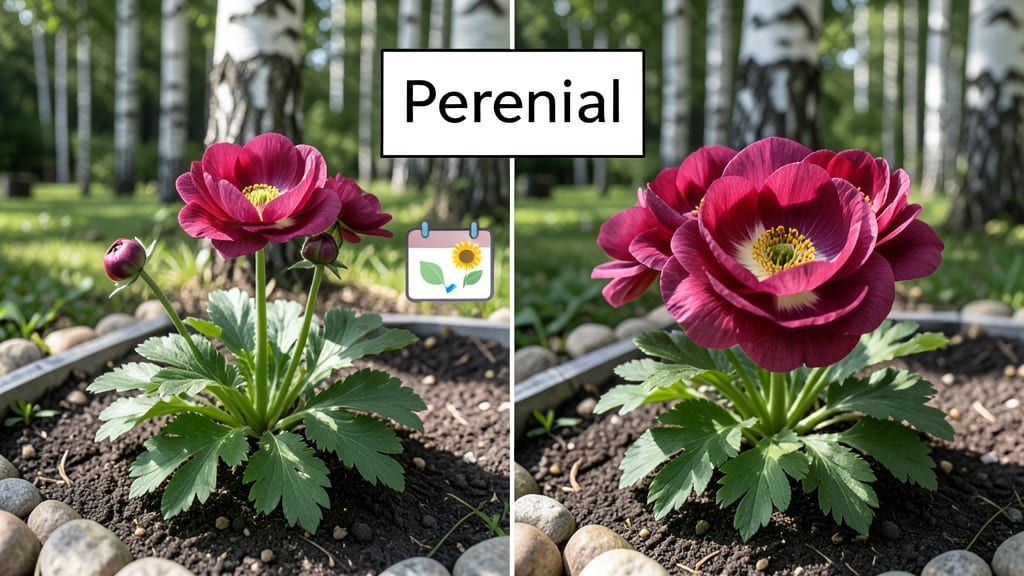
Ranunculus do not bloom every year as perennials in most climates—they typically behave as short-lived perennials or annuals, reblooming only in ideal conditions like mild winters and consistent moisture. Proper care can extend their lifespan for 2-3 seasons before replanting becomes necessary.
Ranunculus flowers rely on underground tubers to store energy, but these tubers often struggle to survive harsh winters or inconsistent moisture levels. 🌱 Unlike true perennials, which regrow reliably each year, ranunculus tubers frequently weaken after their first bloom cycle, especially in colder regions.
I've found that providing winter mulch and well-draining soil can sometimes coax a second season of blooms, but even then, their lifespan rarely exceeds three years without replanting.
What sets ranunculus apart is their dramatic first-year display, which makes them feel like perennials—until they don't return the next season. The key to extending their blooming window lies in mimicking their native Mediterranean conditions: partial shade, consistent watering, and protection from extreme temperature swings.
Many gardeners treat them as annuals for this reason, replanting fresh tubers each spring to guarantee those show-stopping flowers.
💡 In This Article
- Why Ranunculus Often Die Back After First Bloom
- How to Maximize Ranunculus Reblooming for Multiple Seasons
Why ranunculus often die back after first bloom
The ranunculus lifecycle hinges on its underground tubers, which store energy like a biological battery—but these tubers are far less resilient than those of true perennials. Unlike hardy peonies or daffodils, which develop deep root systems that survive decades, ranunculus tubers contain minimal stored nutrients.
After their first spectacular bloom, these tubers often exhaust their reserves, especially in temperatures below 20°F or with inconsistent moisture. 🌱 The result? A dramatic decline in vigor by the second season.
Botanists classify ranunculus as "geophytes"—plants that rely on modified stems (tubers) for survival. These tubers typically contain just 5-10% starch reserves, compared to 20-30% in daffodil bulbs. This low-energy storage means they're highly sensitive to environmental stress.
Even a single hard freeze can trigger irreversible damage, while summer droughts accelerate tuber dehydration. The Mediterranean climate where ranunculus evolved—mild winters and consistent rainfall—creates perfect conditions for reblooming, but most North American gardens fail to replicate these factors.
What makes this lifecycle particularly frustrating is how ranunculus appear perennial during their first year. Their rapid growth and abundant blooms (up to 100 flowers per tuber) create the illusion of reliability, but the reality is these tubers were never designed for multi-year survival.
True perennials like hostas or coneflowers develop extensive root networks that regenerate annually, while ranunculus tubers simply don't have the biological infrastructure for long-term persistence. 💫
Another critical factor is soil health. Ranunculus tubers thrive in well-draining, slightly acidic soil (pH 6.0-6.5), but they're extremely sensitive to compaction or waterlogging. When planted in heavy clay soils, their delicate tubers suffocate, leading to rot within weeks.
This contrasts sharply with peonies, which can tolerate poorer soil conditions while still reblooming reliably. The ranunculus tuber's porous structure makes it particularly vulnerable to both drought and excess moisture—neither of which true perennials face with the same severity.
Here's what's actually happening underground: After blooming, ranunculus tubers enter a dormant phase where they begin breaking down. Unlike bulbs that remain dormant but intact, ranunculus tubers actively decompose unless given perfect conditions.
This decomposition process accelerates in temperatures above 85°F, which is why gardeners in hot climates often see their ranunculus disappear entirely after just one season. The tuber's limited energy reserves get exhausted faster than they can be replenished through photosynthesis.
The comparison to true perennials reveals why ranunculus behave so differently. While peonies can live for 50+ years with proper care, ranunculus tubers typically last just 2-3 seasons before needing replacement.
This fundamental difference in biological structure explains why most gardeners eventually treat ranunculus as annuals—despite their perennial classification in botanical texts. The key insight? Their short-lived nature isn't a gardening failure, but rather a reflection of their evolutionary adaptations to specific Mediterranean conditions that most gardens simply can't replicate. ✨