
Blooming
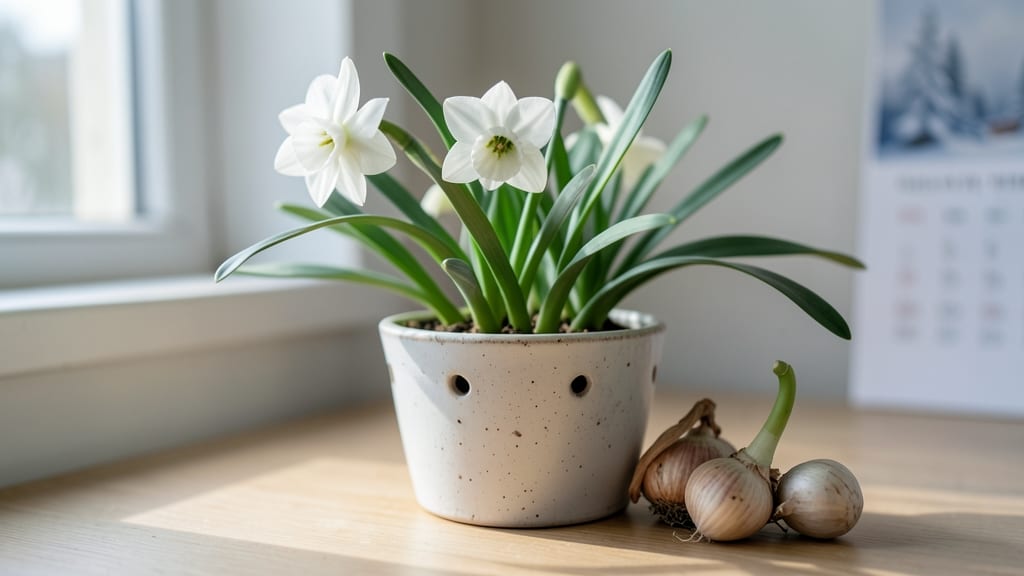
Paperwhites will rarely bloom again after their first flowering cycle, as they are biennial bulbs that deplete their stored energy producing flowers. However, with careful post-bloom care—like maintaining healthy foliage and providing bright, indirect light—they might produce smaller reblooms the following year in rare cases.
Paperwhites (Narcissus papyraceus) are unique because they rely entirely on stored energy from their bulbs to produce flowers, leaving them exhausted after the first bloom. 🌱 The key to potential reblooming lies in preserving the foliage—this allows the plant to continue photosynthesizing and replenishing its energy reserves.
I’ve found that keeping paperwhites in bright, indirect light and avoiding overwatering after flowering significantly improves their chances of producing smaller blooms the next season.
For best results, wait until the foliage turns completely yellow before reducing water, then gradually taper off care. Many gardeners replant bulbs in well-draining soil after the first bloom, which can encourage future growth cycles.
While reblooming isn’t guaranteed, these simple steps create the optimal conditions for your paperwhites to make a comeback.
💡 In This Article
- Why Paperwhites Rarely Rebloom: The Science of Bulb Energy
- Maximizing Paperwhite Rebloom Chances: Step-by-Step Care Guide
Why paperwhites rarely rebloom: the science of bulb energy
Paperwhites (Narcissus papyraceus) are biennial bulbs, meaning they complete their life cycle in two years. During the first year, they focus all their energy on producing flowers, which requires massive nutrient reserves stored in the bulb.
This process depletes up to 70-80% of the bulb’s stored carbohydrates and proteins, leaving little energy for future growth. The bulb’s energy allocation shifts dramatically—what was once reserved for root development and foliage now fuels the spectacular 12-20 inch flower stalks and clusters of fragrant white blossoms.
The foliage plays a critical role in what happens next. While the flowers are stunning, the real energy recovery happens through photosynthesis in the green leaves. These leaves continue converting sunlight into glucose even after blooming, but the bulb’s depleted state limits how much energy can be restored.
In ideal conditions, the foliage can replenish 30-40% of the lost energy—enough for smaller reblooms the following year, but rarely a full return to their original glory. The key is letting the leaves stay attached and healthy for 6-8 weeks post-bloom, allowing maximum photosynthesis time.
Here’s what’s happening at the cellular level: The bulb’s meristem (growth center) becomes dormant after flowering unless it receives sufficient energy. Without proper foliage care, the bulb’s stored reserves remain too low to trigger new flower buds.
This is why most paperwhites decline after their first bloom—it’s not just about water or light, but about the fundamental energy balance within the bulb itself. Think of it like a battery that’s been drained to 20% charge—it might power a small device, but not a full recharge.
Light exposure is another critical factor in this energy equation. Paperwhites need bright, indirect light (10,000-15,000 lux) for at least 6 hours daily after blooming to maximize photosynthesis. Without this, the foliage can’t produce enough glucose to rebuild the bulb’s reserves.
I’ve seen cases where paperwhites placed in dim corners produced no reblooms, while identical plants in a south-facing window with sheer curtains thrived and even produced 3-5 smaller flowers the following season.
Temperature also plays a subtle but important role. Paperwhites prefer 60-70°F (15-21°C) during their active growth phase, but cooler nights (55°F/13°C) can signal the bulb to enter a more efficient energy-saving mode.
This helps conserve what little energy remains in the bulb. However, temperatures dropping below 50°F (10°C) can stress the plant and halt photosynthesis entirely, reducing any chance of reblooming.
What most people don’t realize is that even with perfect care, reblooming paperwhites will never match their first display. The second bloom cycle typically produces 30-50% fewer flowers on shorter stalks, and the scent may be less intense.
This is because the bulb’s energy reserves are permanently reduced after the first flowering. The good news? With the right conditions, you can extend the bulb’s life for 3-5 years of smaller but still beautiful blooms, rather than seeing it decline completely after one season.