
Blooming
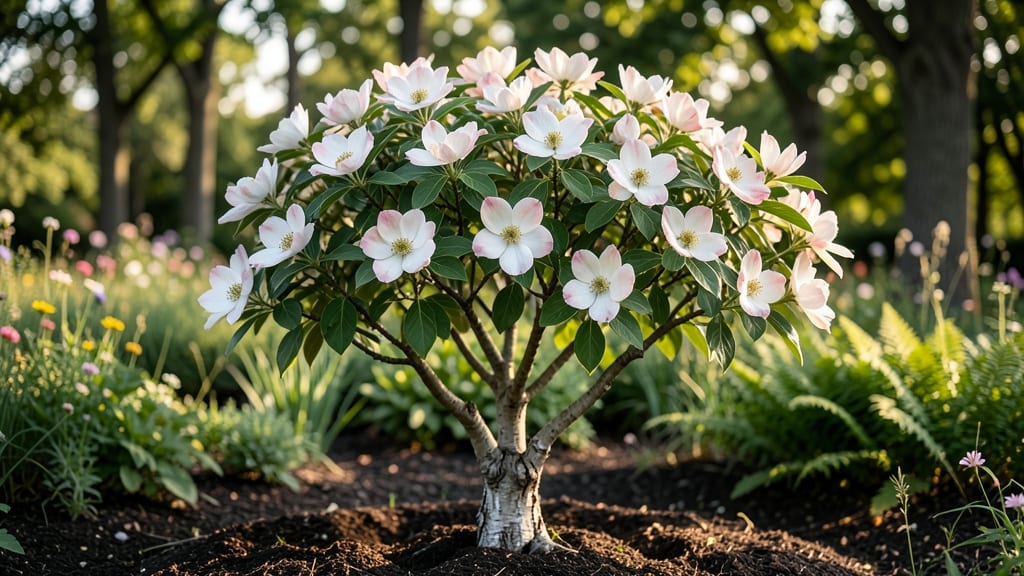
A dogwood bloom looks like four elegant, petal-like bracts in white or soft pink hues surrounding a dense cluster of tiny true flowers at its heart, forming a captivating starburst shape. These showy blossoms appear in spring alongside glossy green leaves that later turn fiery reds and oranges in autumn.
A dogwood's signature beauty comes from its bracts—those large, showy petal-like structures that aren't actually petals but modified leaves. 🌸 These bracts can range from pure white to deep pink, depending on the species, while the true flowers hidden beneath are tiny and often overlooked.
The contrast between the bold outer display and delicate center creates that iconic dogwood silhouette that gardeners love. What's fascinating is how these blooms appear before the leaves fully unfurl in spring, making them one of nature's earliest floral displays.
Beyond the flowers, dogwoods offer year-round interest. Their leaves start as deep green in summer, then transform into brilliant fall colors that rival maples. Even in winter, the tree's distinctive branching pattern and occasional persistent buds provide structure to the landscape.
This multi-season appeal is why dogwoods rank among the most beloved ornamental trees in North American gardens.
💡 In This Article
- Identifying Dogwood Flower Anatomy: Bracts vs True Flowers
- Year-Round Dogwood Tree Visual Characteristics
Identifying dogwood flower anatomy: bracts vs true flowers
The dogwood's showstopping display comes from its four modified leaves called bracts, which serve as the tree's "petals" but aren't true petals at all. These bracts measure about 1-2 inches wide and form a perfect cross shape that frames the central flower cluster.
What's scientifically fascinating is that these bracts are actually sterile—they don't participate in reproduction. Their sole purpose is to attract pollinators with their vibrant colors and striking arrangement. 🌸
The true flowers are hidden beneath those showy bracts, forming a dense cluster of 4-9 tiny white flowers (each just 1/4 inch wide) that together create the "starburst" effect. These true flowers contain both male and female reproductive parts, while the bracts remain purely decorative.
Different dogwood species show remarkable variation: Cornus florida typically displays pure white bracts, while Cornus kousa often features soft pink or even deep red hues. The color intensity can also shift based on sunlight exposure—shadier specimens often develop paler bracts.
Timing plays a crucial role in identification. Dogwoods bloom 2-3 weeks before their leaves fully emerge in late spring, a phenomenon called "prefoliation." This creates a stunning visual contrast between the bold blossoms and the emerging foliage.
The leaves themselves are 4-8 inches long with smooth edges and a distinctive elliptical shape, often described as "leathery" in texture. What makes them unique is their opposite branching pattern—each leaf grows directly across from its counterpart on the stem, creating a perfectly symmetrical appearance.
Here's how to distinguish between common species using flower structure:
- Flowering Dogwood (Cornus florida): Four large white bracts with a smooth, rounded center containing tiny flowers
- Kousa Dogwood (Cornus kousa): Pinkish bracts with a conical shape and larger true flowers (up to 1/2 inch)
- Pacific Dogwood (Cornus nuttallii): Reddish-pink bracts and larger overall size (up to 6 inches across)
The reproductive strategy is equally interesting. While the bracts attract pollinators with their visual appeal, the tiny true flowers produce nectar that rewards insects like bees and butterflies. What's surprising is that dogwoods are self-fertile—meaning a single tree can produce fruit without cross-pollination.
This adaptation explains why you'll often see dogwoods bearing fruit even when planted alone in urban landscapes. 🌿
One common misconception is that all dogwoods produce the same type of fruit. Actually, Cornus florida develops red berries that persist through winter, while Cornus kousa produces blue-black drupes that birds adore. These fruit variations provide another key identification feature for gardeners trying to match trees to their landscape needs.