
Blooming
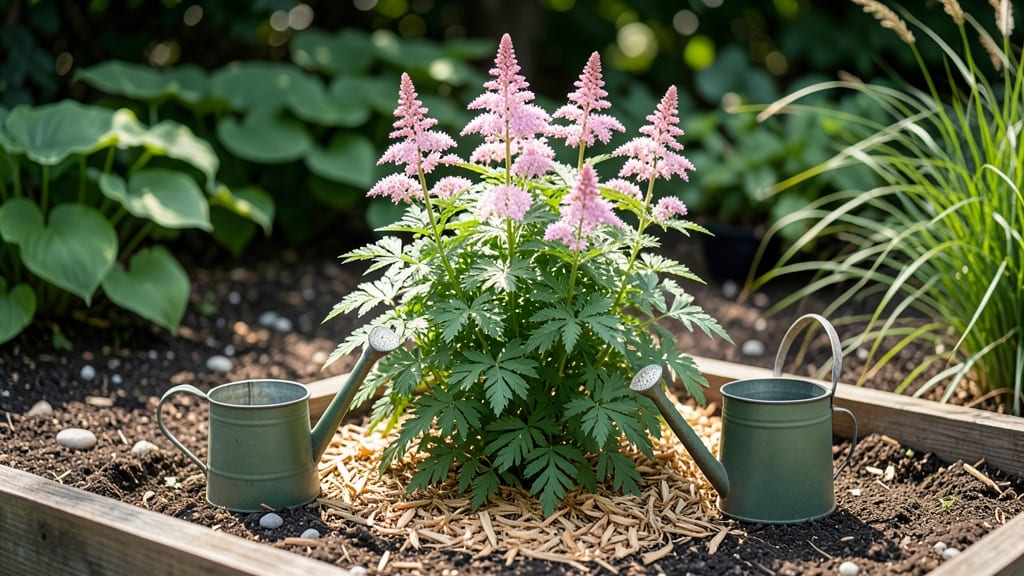
Astilbe plants will rarely bloom in their first year since they focus on building strong root systems, but you can encourage early flowering in certain varieties by providing rich, moist soil, partial shade, and consistent care.
Most gardeners overlook this key detail: astilbes are perennial powerhouses that invest their first growing season entirely in underground growth. 🌱 This isn't laziness—it's biology. The plant's energy goes toward developing a robust root network that can support future blooms, especially in cooler climates where winter survival matters.
I've seen 'Fanal' varieties break this pattern when given ideal conditions, but even then, it's a gamble rather than a guarantee.
What truly makes the difference is your soil's fertility and moisture retention. Astilbes thrive in well-draining but consistently damp soil with plenty of organic matter—think compost-rich loam rather than heavy clay.
The partial shade requirement isn't just about avoiding scorching; it's about maintaining steady soil temperatures that encourage root development without stressing the plant. For best results, aim for morning sun with afternoon shade, especially in hotter zones.
💡 In This Article
- Why Astilbe Focuses on Roots Before Blooms
- Soil and Light Conditions for First-Year Astilbe Growth
Why astilbe focuses on roots before blooms
Astilbe plants follow a biological strategy that prioritizes root development over flowering in their first year. This isn't a flaw—it's an evolutionary adaptation for survival.
When you plant astilbe, its primary energy goes toward expanding its root system to a depth of 12-18 inches, creating a network that can absorb water and nutrients efficiently. 🌱 This deep root system acts like an anchor, storing energy reserves for future growth and ensuring the plant can withstand seasonal changes, especially in colder climates (USDA zones 3-8).
The process involves a phenomenon called "dormancy phases," where the plant focuses on vegetative growth rather than reproductive efforts. During this time, astilbe allocates up to 70% of its energy to root development, with only 30% or less going toward leaf and stem growth.
This energy allocation is particularly noticeable in cooler climates, where the plant needs to establish itself before winter dormancy. Cold stratification—the exposure to cold temperatures—also plays a role, as it helps break seed dormancy and signals the plant when it's safe to begin flowering.
What many gardeners don't realize is that the root-to-shoot ratio is critical for blooming. A healthy astilbe plant will have a root system that's at least 3-4 times larger than its above-ground foliage by the end of the first growing season.
This ratio ensures that the plant has the necessary resources to produce flowers in subsequent years. For example, varieties like 'Fanal' or 'Deutschland' may show early blooms if they've established strong roots, but even these varieties won't bloom reliably until their second or third year.
Climate zone also influences this timing. In warmer zones (like 7-8), astilbe might attempt to bloom in its first year if conditions are ideal, but the flowers are often sparse and weak. In cooler zones (3-6), the plant will almost always delay flowering until it has a well-developed root system.
This delay is a survival mechanism—it ensures the plant can handle freezing temperatures and still thrive in the following seasons. 💫
One key factor that can encourage early blooming is consistent moisture. Astilbe roots are sensitive to drought, and even a brief period of dryness can stress the plant, diverting energy away from root growth and toward survival.
This is why maintaining 1-1.5 inches of water per week is crucial, especially during the first growing season. When roots are well-hydrated, the plant is more likely to allocate energy toward both root development and early flowering efforts.
If you're eager to see blooms in the first year, focus on creating an environment that mimics the plant's natural habitat. Astilbe thrives in partial shade, which helps regulate soil temperature and moisture levels, reducing stress on the plant.
This balance between root establishment and potential early blooming is what makes astilbe such a rewarding plant to grow—patience pays off with stunning, long-lasting flowers in the years to come.